Happy New Year! We always love the new year and the earliest parts of January because for us it feels not just like turning over a new calendar year, but also diving into a new farming season. On the farm, December felt like a decidedly strange month due to the early snow and freezing temperatures, and we found ourselves hoping for some warm days so we could get to sinking fence posts, planting bulbs and winterizing the farm.
In total, we planted around 40,000 bulbs before year end, and we roughly doubled the size of our fenced-in field with the start of a new fence. It was a busy end to the year!
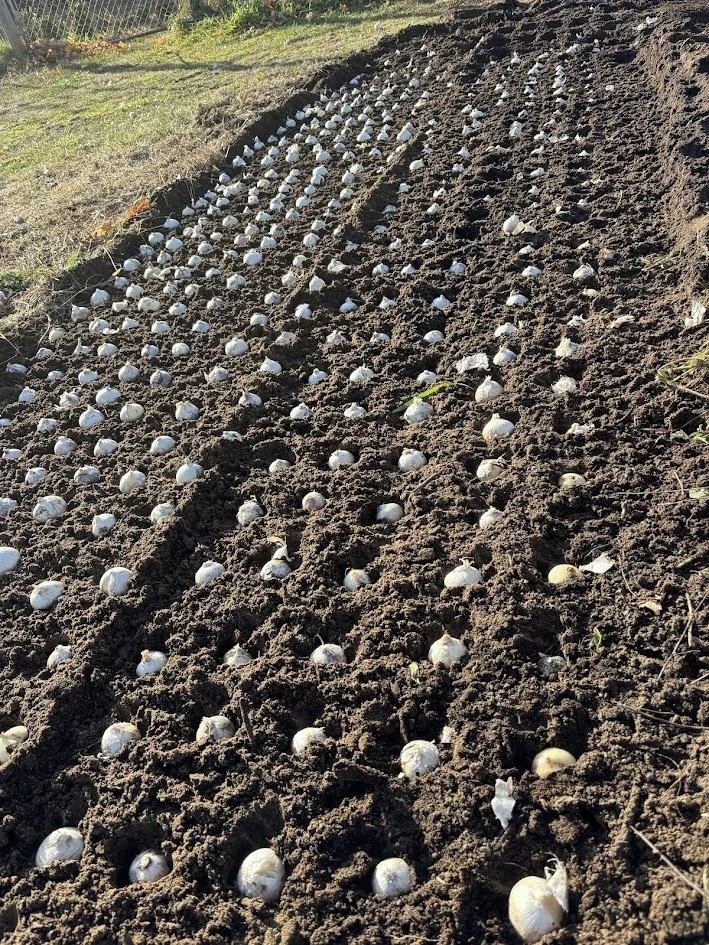
Allium bulbs planted mid-November
But with January upon us, and with December’s final tasks finally completed, let’s turn our attention to January, because there is plenty to do this month, and loads of new things coming to our farm this season.
For January, there will be four main activities on the farm, starting with the beginning lisianthus seeding. Over the next few weeks we will start around 10,000 lisianthus plants in a grow room in our basement. Lisianthus are a notoriously slow grower, and if we don’t get them started now, they won’t be ready for transplant into our high tunnels come March/April. Around 180 days will pass before we start harvesting them in July/August, but the wait is usually worth it for these beauties. Many flower farmers opt to buy plugs for lisianthus and we have done that in the past. However, we don’t love all the packaging and resources it takes to ship plugs plus we like starting seeds.
Our second January activity will also mostly occur in our basement as we will begin the process of splitting and inventorying the 100 or so crates of dahlia clumps that we stored this fall. For those not familiar, in addition to producing an astonishing range of beautiful flowers throughout a growing season, dahlias also multiply their tubers as well, and for those willing to do the work, those tubers can be split before planting again to expand plantings for subsequent seasons. In general, one tuber planted in May can produce between 3-10 new tubers before being dug in the fall.
This past year we grew around 2,500 dahlia plants, about 30 varieties. Going into next year we will expand production of some varieties, reduce production of others, and eliminate some varieties all together based on what grows and sells well for us. We will also introduce about 15 new varieties and expand overall production to around 3,500 plants.
For those of you doing the math at home, you might be thinking that the 2,500 dahlia plants we grew last year will produce far more tubers than the 3,500 that we’re planning for this coming season, and if so, you would be correct. Last year we had enough extra supply of tubers that we were able to hold a small tuber sale in April, which was a surprising success. This year we are planning to hold another, slightly larger sale - more information on that coming soon.
Our third activity will be general maintenance on our tools and equipment - oiling and sharpening snips and pruners, changing tractor fluids, maintenance on small engine equipment, etc. And once that work is done, we’ll put the newly sharpened tools to work with our fourth task, pruning and coppicing all of our shrubs to maximize their productivity for harvest in the 2026 season. Many of the shrubs we grow can be harvested at multiple stages - in bud, in bloom, or after bloom for foliage. Harvesting at the right time, and harvesting the correct way, is the key to ensuring they fill their proper rolls in the coming year. In total, we have about 600 shrubs to maintain, which we should be able to do in a few short days of outside work.
And that’s about it for our January work flows. Our goal is to stay busy, check these tasks off our list, but also to keep a slightly slower paced work day as we recharge for when the work really kicks in a handful of weeks. In this way, it’s nice to try to find some harmony between our work day and the shorter day lengths of winter, getting work done while the sun is up, and transitioning to leisure when it goes down. We hope you’re finding some time for leisure too, and thanks for checking in on us and our January farm tasks!
Amy and Derek